
You land at Menara Airport and the first thing you notice is the heat shimmering off the tarmac. Your mind is likely already racing with images of the Jemaa el-Fnaa and the winding alleys of the Medina. But then you look at the chaos of the arrivals hall. Dozens of drivers are waving signs. Horns are blaring outside.
The excitement of travel quickly meets the reality of logistics. Navigating this city is an art form. It is a dance between ancient dusty paths and modern asphalt roads. If you want your trip to be about the sights rather than the stress of travel, you need to understand the rhythm of the streets. This guide is your map to getting around Marrakech with the confidence of a local.
Table of Contents
The Red City Transport Landscape
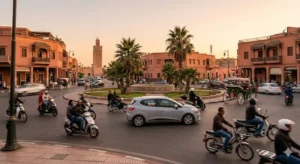
Marrakech is divided into two distinct worlds. You have the Medina, a thousand-year-old fortress where cars are mostly forbidden and the streets are barely wide enough for two people to pass. Then you have the New City, or Gueliz, with its wide French-style boulevards and traffic lights. Your strategy for travel changes depending on which wall you are standing behind. One minute you are dodging a donkey cart; the next, you are hailing a sleek electric bus. Understanding this divide is the first step to a smooth journey.
Walking the Medina Maze
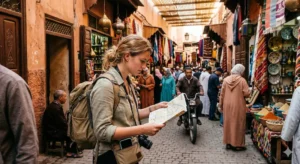
Within the pink walls of the old city, your feet are your best friends. In fact, for most of the Medina, they are your only option. You will share the space with motorcycles that seem to appear out of nowhere and carts piled high with mint. It feels chaotic, but there is an unspoken order. Keep to the right. Watch the ground for uneven stones. Most importantly, do not rely solely on your phone’s GPS. The tall stone walls often block satellite signals, leaving your blue dot spinning in circles. Instead, look for landmarks. A specific archway or a colorful spice stall can be a much better guide than a digital map that thinks you are three streets over.
The Rise of Eco-Friendly Travel
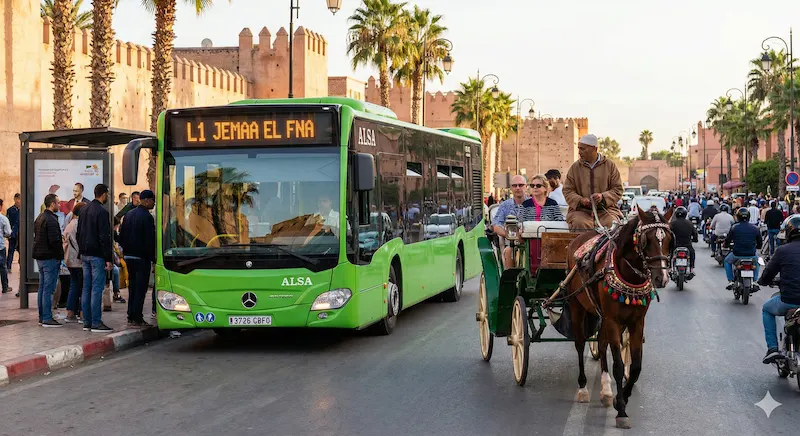
You might be surprised to see bright green buses gliding quietly past ancient ruins. Marrakech has made a massive push toward sustainability. Since hosting major climate summits, the city has introduced a fleet of electric buses. These are clean, air-conditioned, and surprisingly punctual. If you are staying in Gueliz but want to visit the Majorelle Garden or the Menara Mall, these buses are a fantastic choice. They offer a glimpse of a modern Morocco that respects its environment while moving its people efficiently.
Taking a Taxi Without the Headache
Taxis are the lifeblood of transport here. You will see them everywhere, buzzing around like bees. But for a newcomer, the system can feel like a riddle. There are two types of taxis, and using the wrong one for your specific trip will cost you time and money. When you think about getting around Marrakech, the taxi will likely be your most frequent choice of vehicle.
Petit Taxis: The Urban Sprinters
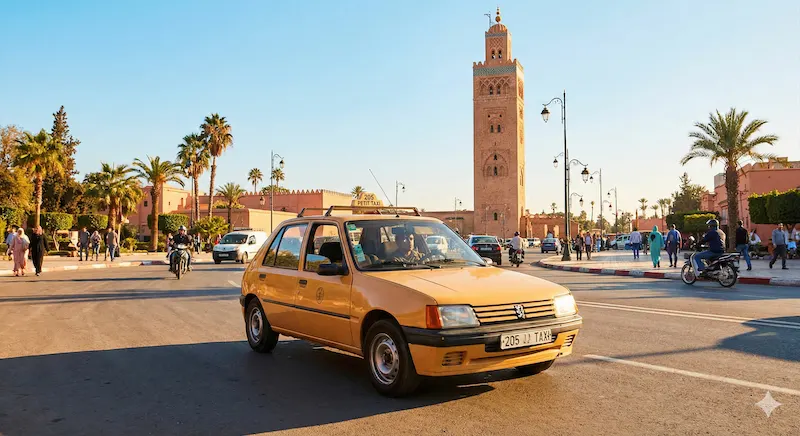
These are the small, ochre-colored cars you see darting through traffic. They are strictly for travel within the city limits. They can carry a maximum of three passengers. If you see one with two people already inside, you can still hail it. The driver will pick you up if you are heading in the same general direction. Each passenger pays for their own journey. It is a shared-ride system that works remarkably well once you get used to it.
- The Meter is King: Always insist on the meter (the “compteur”). A driver might tell you it is broken. It rarely is. If they refuse to turn it on, simply get out and find another. There are thousands of them.
- Night Rates: Be aware that after 8:00 PM, a legal 50% surcharge is added to the metered price. This is standard and not a scam.
- Small Change: Drivers rarely have change for large bills. Keep a pocket full of 10 and 20 dirham notes to avoid an awkward standoff at your destination.
Grand Taxis: The Long-Distance Cruisers
These are larger vehicles, often older Mercedes-Benz sedans or newer minivans. They are silver or white. Unlike the Petit Taxis, these can leave the city limits. Use these if you are planning a day trip to the Ourika Valley or heading to the Palmerie. They operate on fixed routes and only leave when they are full. If you want the car to yourself, you can pay for all six seats. It is a more expensive way of getting around Marrakech, but it gives you total control over your schedule.
Navigating Public Buses and Carriages
If you want to save your dirhams for the souks, the bus system is your best bet. The ALSA bus company runs a very reliable network that connects the suburbs to the heart of the city. The buses are generally safe, though they can get very crowded during rush hour. You enter through the front door and pay the driver directly. The tickets are incredibly cheap, usually just a few dirhams.
The L1 Electric Bus Route
This specific route is a favorite for visitors. It connects the high-end hotels of the Hivernage district with the Jemaa el-Fnaa. It is easy to spot, clean, and runs frequently. If you are nervous about your first bus ride in Morocco, start with this one. It is a gentle introduction to the system and very easy to navigate.
The Caleche: A Slower Pace
You will see green horse-drawn carriages lined up near the big hotels and the main square. These are called Caleches. They are not really for “getting from A to B.” They are for the experience. A ride around the city walls at sunset is a classic Marrakech moment. It is romantic, slow, and gives you a perspective you can’t get from a car window. Always agree on the price before you climb in. Most rides are based on an hourly rate, so clarify exactly how long the tour will last before the horse starts moving.
| Mode of Transport | Typical Use | Estimated Cost (MAD) | Pro Tip |
|---|---|---|---|
| Petit Taxi | Quick trips within city | 15 – 30 (Metered) | Always check the meter starts at zero. |
| ALSA Bus | Budget travel | 4 – 5 per person | Have exact change ready. |
| Airport Shuttle (L19) | Airport to Medina | 30 (Round trip) | The ticket is valid for two weeks. |
| Caleche | Sightseeing tour | 150 – 250 per hour | Agree on the route beforehand. |
From Menara Airport to the City Center
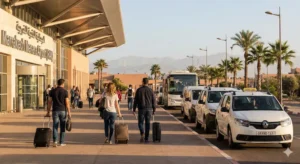
The first journey is often the hardest. When you arrive, you have three main choices. The L19 Express Bus is the most efficient. It leaves every 20 minutes and stops at all the major landmarks, including the train station and Jemaa el-Fnaa. It is affordable and has plenty of room for luggage. Your second option is a taxi. There is a fixed-price board at the airport exit. Take a photo of it.
Some drivers might still try to quote a higher price, but you can simply point to the board. Your third option is a pre-arranged transfer through your Riad. This is the most expensive but the least stressful. A driver will meet you with your name on a sign and walk you directly to your accommodation.
Why Riad Transfers Save Your Sanity
If you are staying deep in the Medina, your taxi cannot reach your door. You will be dropped at the nearest gate. From there, you have to find your way through a maze of identical-looking streets. A Riad transfer usually involves a member of the staff meeting you at the taxi drop-off point. They will guide you through the alleys, often with a cart for your bags. For your first night, this service is worth every penny. It prevents that initial moment of feeling lost and vulnerable in a new city.
Driving Yourself: Is It a Good Idea?
You might be tempted to rent a car. If you plan on exploring the Atlas Mountains or the coast, a car is great. But for getting around Marrakech itself? It is often more trouble than it is worth. Parking is a nightmare. The rules of the road are more like “suggestions.” Scooters will weave between you and the sidewalk without warning. If you do rent a car, make sure your hotel has secure parking. Never leave valuables in the car, even for five minutes. Most parking spots are “managed” by men in orange vests. They aren’t official city employees, but they do watch the cars. A few dirhams when you leave is the expected payment for their service.
Navigating the Roundabouts
The roundabouts in Marrakech are legendary. They are the heart of the traffic flow. The most important rule to remember is that traffic entering the roundabout often has priority, which is the opposite of many European and American systems. Look for the signs. If there is no sign, be very cautious. It is a game of eye contact and bravery. If you aren’t a confident driver, let the taxi professionals handle the roundabouts while you enjoy the view from the back seat.
Practical Tips for a Stress-Free Journey
Success in Moroccan travel comes down to preparation. You don’t need a degree in logistics, but a few simple habits will make your life much easier. Whether you are catching a bus or walking the souks, these tips apply to every traveler.
- Download Offline Maps: Use an app that allows you to download the city map. Even when the signal drops, the basic street layout will still be there.
- Learn Basic Phrases: A little bit of Arabic or French goes a long way. “Afak” (Please) and “Shukran” (Thank you) open many doors. If you can ask “Fin l-moukafa?” (Where is the stop?), you will get much better help.
- Comfortable Shoes: This is not a city for heels or brand-new leather boots. The streets are dusty and the distances are longer than they look on a map.
- Stay Hydrated: Travel takes energy. Always carry a bottle of water. You can buy it at any “Hanout” (small corner shop) for a fraction of the price you’d pay in a hotel.
Dealing with Overly Helpful “Guides”
While getting around Marrakech, you will inevitably be approached by people offering to show you the way. Many are genuinely kind. Some are looking for a tip. If you are lost, go into a shop and ask the owner for directions. They are stationary and less likely to expect a payment for pointing you in the right direction. If someone follows you, a polite but firm “La, shukran” (No, thank you) while continuing to walk is the best response. Do not stop. Keep moving toward a main square or a busy street.
The Future of Marrakech Transport
Looking ahead into 2026 and beyond, the city is only becoming more connected. There are talks of expanding the electric bus lines even further into the outskirts. The train station is already one of the most beautiful in Africa, connecting you to Casablanca and Tangier via high-speed rail. Marrakech is a city that understands its role as a global destination. It is working hard to make sure you can get from your Riad to a desert dinner without a hitch.
A Final Word on Patience
Everything in Morocco takes a little longer than you think. A ten-minute taxi ride might take twenty if a parade or a market spill blocks the road. Don’t fight it. This is part of the experience. Use the extra time to look out the window. Watch the bread sellers. See the way the sun hits the red city walls. The journey is just as much a part of your holiday as the destination itself.
FAQs About Getting Around Marrakech
What is the best way of getting around Marrakech?
For most visitors, a combination of walking and Petit Taxis is the most effective way of getting around Marrakech. The Medina is best explored on foot because the alleys are too narrow for cars. For longer distances between the old city and the new city (Gueliz), Petit Taxis are quick and affordable.
How do I pay for transport in Marrakech?
Cash is the only way to pay for almost all local transport. While high-end hotels and restaurants take cards, taxi drivers, bus drivers, and horse carriage operators only accept Moroccan Dirhams. Always keep small coins and 10 or 20 dirham notes in your pocket to make payments easy.
Is it easy for tourists to use the bus in Marrakech?
Yes, the ALSA bus system is quite straightforward. You enter the front door, pay the driver a flat fee, and take your ticket. Route L1 and L19 are particularly popular with travelers because they connect major tourist hubs and the airport with the city center.
Are taxis safe in Marrakech at night?
Taxis are generally very safe at night. Just remember that the legal night rate starts at 8:00 PM and adds a 50% surcharge to the meter. Stick to the official ochre-colored Petit Taxis and ensure they are registered vehicles with a visible license number on the door.
Can I walk from the Medina to the New City?
You can certainly walk from the Medina to Gueliz. The walk from Jemaa el-Fnaa to the heart of the New City takes about 20 to 30 minutes along the broad Avenue Mohammed V. It is a straight, flat path that offers great views of the Koutoubia Mosque along the way.
Ready to Explore the Red City?
You now have the tools to navigate the streets of Marrakech like a seasoned traveler. From the cheap thrills of the ALSA bus to the romantic slow-burn of a Caleche ride, the city is yours to discover. Don’t let the noise and the crowds hold you back. Step out of your door and join the flow. Whether you are hunting for the perfect rug or the best sunset view, getting there is half the fun. Your Moroccan adventure is waiting for you just around the next corner. Book your airport transfer now and start your journey with total peace of mind!