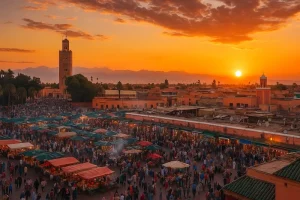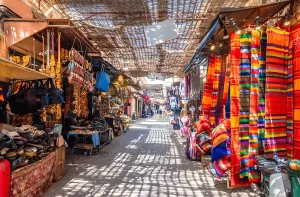
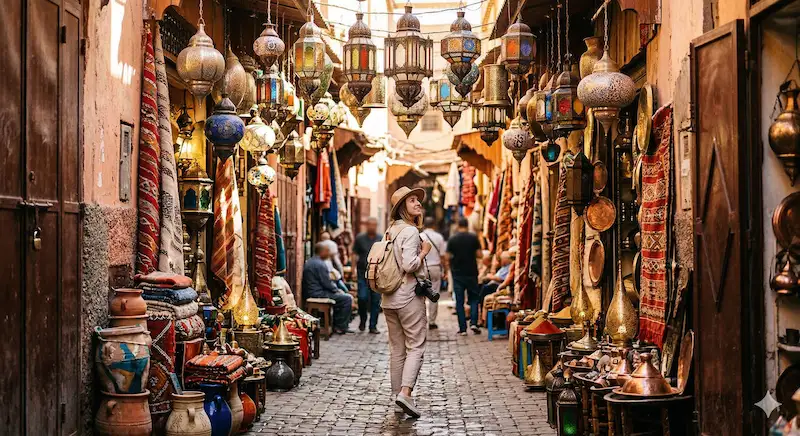

You step off the sun-drenched edges of Jemaa el-Fnaa and into the shaded, labyrinthine alleys of the medina. Immediately, your senses are hijacked. The scent of cumin and cedarwood fills the air, motorbikes weave through impossibly narrow gaps, and a kaleidoscope of colorful ceramics, intricate rugs, and gleaming brass lanterns surrounds you. Welcome to the souks of Marrakech. Here, shopping isn’t just a transaction; it is a sport, a centuries-old social ritual, and an immersive cultural experience.
If you are planning to take home a piece of Moroccan craftsmanship, you absolutely need to know how to bargain in Marrakech. For many visitors, the idea of haggling induces anxiety. You might worry about offending the vendor, paying too much, or simply making a fool of yourself. But once you understand the rhythm of the negotiation, you will realize that haggling is not an argument—it is a collaborative dance.
This definitive guide will strip away the mystery of the medina’s pricing structure. By the time you finish reading, you will possess the confidence to sip mint tea, exchange friendly banter, and secure a fair price for your treasures while leaving both yourself and the shopkeeper smiling.
Table of Contents
Understanding the Culture of Haggling in Morocco
Before you even ask for a price, you must shift your mindset. In Western cultures, the price tag is final. In Morocco, the initial price is merely the opening line of a conversation.
When you ask a merchant, “How much?”, they are not just evaluating the item; they are evaluating you. They consider your interest level, your origin, and your willingness to play the game. Merchants in the medina are masters of psychology. They respect a buyer who knows how to negotiate playfully. Refusing to bargain or instantly accepting the first price actually deprives both of you of the traditional social interaction that defines Moroccan commerce.
The Ritual of Mint Tea
Do not be surprised if a larger negotiation—say, for a Berber rug or a substantial leather travel bag—is interrupted by an offer to sit down for sweet Moroccan mint tea. This is a sign of hospitality, but it also serves to slow down the pace. Accept the tea. It does not legally bind you to buy the item, but it shows respect for the vendor’s time and culture. It transforms you from a passing tourist into an honored guest, setting a positive tone for the financial discussion that follows.
Essential Preparation Before Entering the Medina
Winning the haggling game starts before you ever set foot in the souks. Your preparation dictates your confidence, and confidence is your greatest currency.
1. Establish Your Baselines at Fixed-Price Shops
If you have no idea what a hand-painted tagine or a pair of leather slippers (babouches) is actually worth, you cannot negotiate effectively. Spend your first day visiting a fixed-price artisan center, such as the Ensemble Artisanal located just outside the medina. The prices here are non-negotiable and generally represent the “fair but slightly premium” retail value. Use these numbers as your mental anchor. If the Ensemble Artisanal sells a specific lantern for 300 dirhams, you know your target price in the souk should be around 200 to 250 dirhams.
2. Carry Small Bills and Exact Change
Cash is king in the souks. While high-end carpet dealers take credit cards, the vast majority of stalls deal exclusively in Moroccan Dirhams (MAD). Break your larger notes (200 MAD) at restaurants or your hotel before shopping. If you negotiate a hard-fought price of 60 dirhams for a scarf and then hand the vendor a 200-dirham note, they will suddenly—and magically—have no change. Carrying smaller coins and bills gives you leverage and finality in the transaction.
3. Dress the Part
Your appearance communicates your budget. If you walk into a shop wearing flashy designer clothing, an expensive watch, and carrying a high-end camera, the starting price will instantly triple. Dress comfortably, modestly, and casually. Blend in as a seasoned traveler rather than a wealthy tourist.
The Step-by-Step Guide: How to Bargain in Marrakech
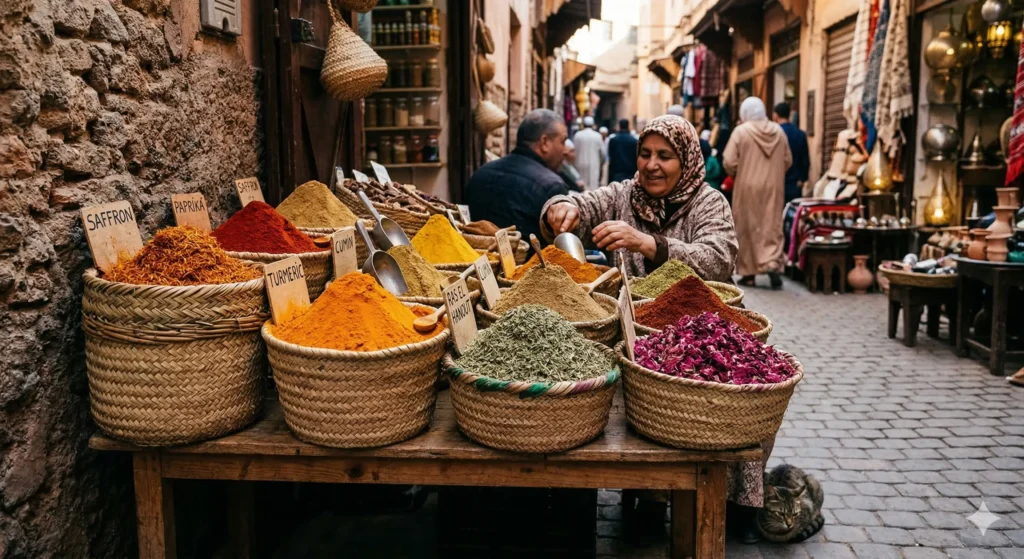
Now that you are prepared, it is time to engage. Follow this sequence to navigate the negotiation smoothly and effectively.
Step 1: The Poker Face and the Casual Approach
When an item catches your eye, do not rush toward it with a gasp of excitement. Maintain a neutral expression. If the vendor knows you are already emotionally attached to that specific blue ceramic bowl, your negotiating power drops to zero. Browse casually. Look at three or four other items first. Ask the price of things you do not actually want to buy just to test the vendor’s pricing strategy.
Step 2: Let Them Make the First Move
Eventually, direct your attention to the item you actually desire. Ask, “How much is this?”
A common vendor tactic is to reply with a question: “How much will you pay?” or “How much is it worth to you?” Do not answer this. Never set the opening price. Smile politely and say, “I don’t know, you are the seller. Please give me your best price.” Force them to lay down the first number.
Step 3: The Flinch and the Counter-Offer
Whatever number the vendor gives you, it is going to be high. It will likely be two, three, or even four times the item’s actual value. Your job is to act mildly surprised. A soft chuckle or a raised eyebrow works wonders.
Now, it is time for your counter-offer. A good rule of thumb on how to bargain in Marrakech is to counter with 25% to 30% of their initial asking price.
For example: If they ask for 400 dirhams, you offer 100 dirhams.
They will act shocked. They might say you are trying to ruin them. This is all part of the theater. Keep smiling.
Step 4: The Theatrical Back-and-Forth
The merchant will drop their price from 400 to maybe 320. You inch your price up from 100 to 120.
They might point out the incredible craftsmanship, the “antique” nature of the item, or the high quality of the materials. Listen respectfully, acknowledge the beauty of the piece, but hold your ground firmly.
You will go back and forth. 300. 140. 250. 160.
The goal is to meet somewhere around the 40% to 50% mark of their original asking price—in this case, around 180 to 200 dirhams.
Step 5: The “Walk Away” Technique
If you hit a stalemate and the vendor refuses to drop down to your maximum budget, deploy the most powerful tool in your arsenal: the walk-away.
Politely say, “Thank you, it is beautiful, but that is too much for me. Have a good day.” Turn around and slowly start walking out of the stall.
Nine times out of ten, you won’t make it three steps before you hear, “Wait, my friend! Come back. What is your final price?” At this point, you have the upper hand. If they let you keep walking, you know you genuinely hit their absolute bottom line. You can always come back five minutes later and accept their final offer if you really want the item.
Step 6: Sealing the Deal
Once you agree on a number, the negotiation is over. Shake hands, smile, and hand over the cash. Never agree on a price and then change your mind or try to negotiate further. In Moroccan culture, an agreed-upon verbal price is a binding contract of honor.
Item-Specific Haggling Tips: What to Buy and What to Look For
Different items require different approaches. Here is how to handle the most popular souvenirs when shopping in the medina.
Moroccan Rugs and Carpets
Buying a rug is the ultimate test of how to bargain in Marrakech. This process can take hours.
- Quality Check: Authentic Berber rugs are made of wool, not synthetic blends. To test this, ask the merchant to safely burn a tiny fiber. Wool smells like burning hair and turns to ash; synthetics smell like plastic and melt into a hard bead.
- Pricing: Prices vary wildly based on size, age, knot density, and whether it is an Arab (intricate, urban designs) or Berber (geometric, tribal designs) rug. Never accept the first price on a rug; the markup is astronomical.
- Shipping: If you are buying a large carpet, negotiate the shipping costs into the final price before you shake hands.
Leather Goods (Bags, Pouffes, and Babouches)
Marrakech is famous for its tanneries, making leather an excellent buy.
- The Smell Test: Genuine, traditionally tanned Moroccan leather often has a distinct, pungent smell. Be wary of leather that smells strongly of chemicals or plastic.
- Types of Leather: Camel leather is the thickest, stiffest, and most durable (great for heavy travel bags). Cow leather is standard. Goat and sheep leather are incredibly soft and typically used for jackets or delicate slippers.
- Examine the Stitching: Check the zippers and inner linings. Often, the leather is beautiful, but the hardware is cheap. Use this as a bargaining point to lower the price.
Argan Oil and Spices
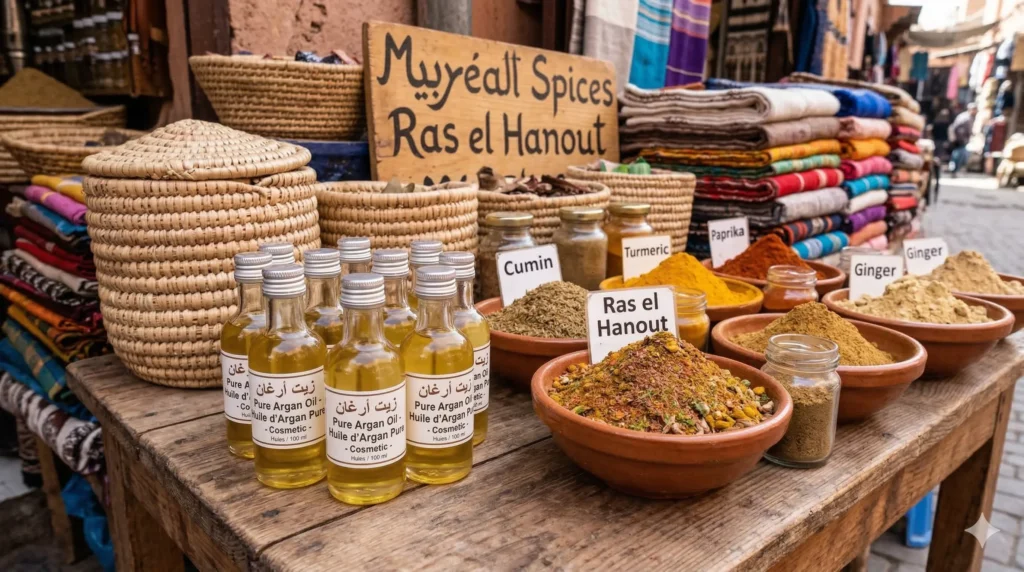
You will see mountains of spices and bottles of liquid gold (argan oil) everywhere.
- Argan Oil: Only buy cosmetic argan oil from certified cooperatives or reputable pharmacies, not from open-air souk stalls in clear glass bottles. Sunlight destroys the oil’s beneficial properties, and cheap tourist bottles are often diluted with vegetable oil.
- Spices: Ras el Hanout (the classic Moroccan spice blend) makes a wonderful gift. Buy whole spices if possible and ask them to grind them in front of you for maximum freshness. Haggling on spices is less intense than rugs, but you should still aim for a 20-30% discount if buying in bulk.
Common Mistakes to Avoid While Bargaining
Even armed with the best tactics, beginners often fall into a few predictable traps. Keep these pitfalls in mind:
- Showing desperation: If you say, “I have been looking for this everywhere!” the price will not drop. Keep your emotions in check.
- Feeling guilty for haggling: You are not taking advantage of the merchant. They are seasoned businessmen making a living. They will never sell an item at a loss. If they accept your price, they are making a profit.
- Getting angry or frustrated: The moment you raise your voice or lose your temper, you have lost the game. Haggling should always remain friendly, respectful, and lighthearted.
- Haggling over pennies: If you are arguing over 10 dirhams (about $1 USD), ask yourself if it is worth the energy. Sometimes, it is better to concede a tiny amount as a gesture of goodwill to the vendor.
When You Should NOT Haggle
While bargaining is expected in the souks, there are places in Marrakech where the practice is inappropriate:
- Restaurants and Cafes: Food and drink prices are printed on the menu and are fixed. Do not try to negotiate your tagine bill.
- Pharmacies: Medicines, genuine argan oil from proper pharmacies, and toiletries have fixed prices.
- Boutiques in Gueliz: The modern, European-style neighborhood of Gueliz operates like any Western shopping district. Prices in boutiques with barcode scanners and air conditioning are generally non-negotiable.
- Taxis: While you must negotiate your taxi fare before getting into the car (unless they agree to use the meter, which is rare for tourists), this is not a playful souk haggle. This is a firm, rapid boundary-setting exercise. Know the standard rate to your destination and insist on it.
Frequently Asked Questions About Shopping in the Medina
Is it rude to walk away without buying anything?
Not at all. Browsing is completely acceptable. It only becomes rude if you enter into a serious, prolonged negotiation, agree on a final price, and then walk away.
Do they speak English in the souks?
Yes. While Arabic and French are the primary languages, the shopkeepers in Jemaa el-Fnaa and the surrounding medina deal with global tourists daily. They speak excellent English (and often Spanish, Italian, and German) when it comes to commerce and numbers.
What happens if I get lost while shopping?
You will get lost. Accept it as part of the experience. Look out for signs pointing to “Jemaa el-Fnaa” (the main square) or “Place des Épices.” If you need directions, ask a shopkeeper rather than a random teenager on the street, as the latter might demand money for “guiding” you.
Conclusion: Embrace the Chaos and Enjoy the Game
Learning how to bargain in Marrakech transforms an overwhelming maze into an interactive, vibrant playground. The souks are the beating heart of the city’s trade history, and participating in the haggling ritual connects you to a tradition that has thrived for centuries along these dusty, sunlit pathways.
Remember to smile, know your limits, carry small change, and never be afraid to politely walk away. Every carpet, lantern, and spice packet you bring home will carry a story—not just of the artisan who made it, but of the tea you drank, the jokes you shared, and the negotiation you mastered to make it yours.
Ready to explore beyond the souks?
Shopping is just one small slice of the Red City’s magic. Whether you want to discover hidden palaces, navigate the best rooftop restaurants, or plan your entire itinerary, we have you covered. Check out our ultimate list of the best things to do in Marrakech to craft your perfect Moroccan adventure today!