



You have spent hours navigating the chaotic, spice-scented labyrinth of the medina. You have drank endless glasses of sweet mint tea, engaged in the theatrical dance of haggling, and finally, you have found it: the perfect, hand-woven Berber masterpiece. But as the merchant rolls up this massive, heavy textile, a wave of panic washes over you. How on earth are you going to get this giant carpet back to your living room in New York, London, or Sydney?
When shopping for rugs, Marrakech presents a logistical challenge that catches many travelers off guard. The thrill of the purchase quickly collides with the reality of international logistics. It is a common scenario. You stare at a carpet that weighs thirty pounds and realize it will never fit into your carry-on luggage. Suddenly, the incredible deal you negotiated feels overshadowed by the looming dread of exorbitant shipping fees and complex customs forms.
Do not let the fear of shipping deter you from bringing home a piece of authentic Moroccan craftsmanship. Shipping large carpets is a daily occurrence in the Red City. A well-established infrastructure exists specifically to help tourists get their treasures home safely. This comprehensive guide will walk you through every single option available to you, detailing the costs, the reliable companies, and the bureaucratic hurdles you need to anticipate so you can focus on enjoying your purchase rather than stressing over its transit.
Table of Contents
The Golden Rule: Negotiate Shipping BEFORE You Pay

The biggest mistake you can make when buying rugs Marrakech merchants sell is separating the price of the item from the price of the shipping. Once you hand over the cash or run your credit card for the carpet itself, you lose all your leverage.
When you reach the final stages of your negotiation, and you are nearing a price you find acceptable, introduce the logistics. Say, “I will pay that price, but only if it includes door-to-door shipping to my home country.” Merchants in the medina have deep, long-standing relationships with local shipping agents and international couriers like DHL and FedEx. They secure bulk corporate rates that are drastically lower than what you would pay if you walked into a shipping office off the street.
Often, the merchant will agree to absorb the cost of standard shipping to close a high-value sale. If they cannot cover the entire cost, they can almost certainly offer you a highly subsidized rate. Always clarify exactly which shipping method they intend to use, the estimated delivery time, and whether a tracking number will be provided.
Option 1: Flying Your Rug Home as Excess Baggage
Before you look into postal services or private couriers, consider taking the carpet on your flight. This is often the safest and most cost-effective method, provided you understand your airline’s specific baggage policies.
The Vacuum Sealing Technique
You might be looking at a thick, plush Beni Ourain carpet and thinking there is no physical way to check it onto a plane. You will be amazed at what a vacuum cleaner can accomplish. Almost every reputable carpet dealer in the medina owns an industrial vacuum sealer. They will place your massive rug into a heavy-duty plastic sleeve, attach a hose, and suck out all the air.
A rug the size of a small car can be compressed into a tight, hard brick that easily fits into a standard large suitcase or a sturdy duffel bag. If you do not have an extra bag, merchants often sell inexpensive, woven plastic bags specifically for this purpose.
Calculating Airline Fees
Checking an extra bag is almost always cheaper than international shipping. If you are flying back to Europe on a budget airline like Ryanair or easyJet, an extra checked bag might cost you between €40 and €60 if purchased in advance online. If you are flying to North America with Royal Air Maroc, Air France, or Delta, an additional piece of luggage typically costs between $100 and $200.
Compare this to courier shipping, which can easily exceed $300 for a heavy item. The only caveat is weight. Most airlines cap standard checked bags at 23kg (50 lbs). If your rug weighs more than this, you will be hit with severe heavy baggage penalties, which can quickly negate your savings. Always weigh the compressed package at your riad or hotel before heading to Marrakech Menara Airport.
Option 2: Using the Merchant’s Shipping Service
If your purchase is simply too massive for an airplane, or you are continuing your travels to other countries before heading home, utilizing the merchant’s shipping contacts is your next best bet.
How the Process Works
When you rely on the shopkeeper to handle the freight, they act as the middleman between you and the courier. They will pack the item, fill out the customs declarations, and arrange for the pickup. This is highly convenient, but it requires a significant amount of trust.
Crucial Steps for Your Protection
The vast majority of carpet dealers in the souks are honest businessmen who rely on word-of-mouth recommendations and positive online reviews. However, mistakes happen, and occasionally, tourists fall victim to scams where a different, lower-quality rug is shipped instead of the one purchased. To protect yourself, follow these non-negotiable steps:
- Photograph Everything: Take clear, high-resolution photos of the exact rug you purchased, making sure to capture any unique knots, patterns, or minor flaws that identify it.
- Sign the Back: Ask the merchant for a thick permanent marker and sign your name on the back corner of the rug. Take a photo of your signature. This guarantees the exact carpet you bought is the one that arrives at your door.
- Photograph the Packaging: Watch them pack the rug if possible. Take a photo of the packed bundle.
- Demand the Airway Bill immediately: Do not leave the shop until the merchant has initiated the shipping process online and provided you with a printed or emailed tracking number (Airway Bill). Do not accept promises of “I will WhatsApp you the tracking number tomorrow.”
- Get an Itemized Receipt: Ensure the receipt lists the dimensions, colors, style, and the exact amount paid for both the item and the shipping.
Option 3: Independent Couriers (DHL, FedEx, UPS)
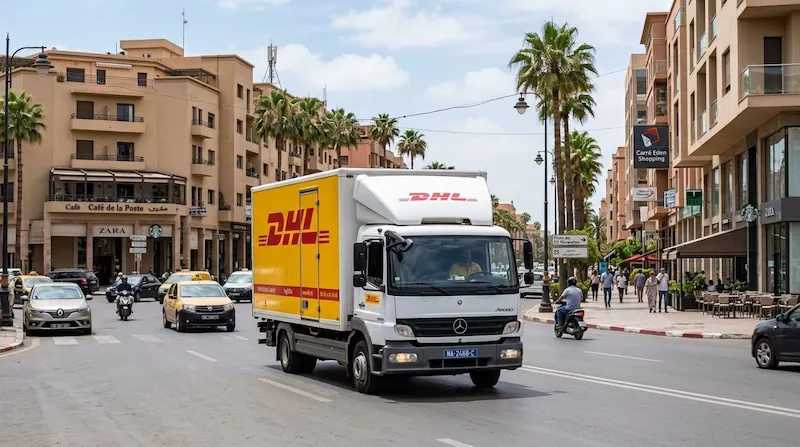
If you prefer to maintain total control over the process, you can bypass the merchant entirely and handle the shipping yourself using major international courier networks. This is the fastest, most reliable, and most easily trackable method, but it is also the most expensive.
Finding Courier Offices in Marrakech
You will not find large DHL or FedEx processing centers deep inside the pedestrian-only zones of the medina. You will need to take your wrapped rug to the newer part of the city, Gueliz. There are several authorized shipping centers located along Avenue Mohammed V and its side streets.
Estimating Courier Costs
Courier pricing is calculated based on “volumetric weight” (the size of the package) or the actual physical weight, whichever is greater. Because rugs are heavy, you will usually pay based on sheer pounds or kilograms.
To give you a rough estimate, shipping a medium-sized (5×7 feet) rug weighing roughly 15kg (33 lbs) via DHL from Morocco to the United States will generally cost between $250 and $400 USD. Shipping that same rug to the United Kingdom or mainland Europe will cost between €150 and €250. Transit times are incredibly fast, often taking only 3 to 7 business days to reach Western destinations.
When investigating rugs Marrakech shipping logistics, remember that fuel surcharges and seasonal demand fluctuate, so these prices are just baselines. Always ask the courier to confirm if the quote includes customs clearance fees (brokerage fees) on their end, as this can add unexpected costs upon delivery.
Option 4: Poste Maroc (Amana International)
If you have time to spare and want to save a substantial amount of money compared to private couriers, the official Moroccan postal service, Poste Maroc, is a viable alternative.
The Amana Service
Poste Maroc operates a specialized international parcel service called Amana. It is significantly cheaper than DHL or FedEx. Shipping that same 15kg rug to the US might only cost $100 to $150 USD via Amana, and even less to Europe.
The Trade-Offs
The lower price comes with distinct compromises. First, the transit time is drastically slower. A package sent via Amana can take anywhere from three weeks to three months to arrive, depending on whether it travels by air freight or cargo ship. Secondly, the tracking system is notoriously unreliable. Your package might show as “Dispatched from Casablanca” for six weeks straight, only to suddenly appear on your porch without any intermediate tracking updates.
If you choose this route, you must visit a main post office (the large central post office in Gueliz at Place du 16 Novembre is your best bet). You will need your passport, and you must fill out customs declaration forms in French or Arabic. It requires patience and a willingness to navigate local bureaucracy, but the financial savings can be immense.
Navigating Customs, Duties, and Import Taxes
Paying for the physical transit of your carpet is only half the battle. The second hurdle is your home country’s government. When your package crosses your national border, customs officials will inspect the documentation to determine if you owe import duties or taxes. Ignorance of these laws is not an excuse, and couriers will hold your rug hostage until these fees are paid.
Shipping to the United States
American travelers have a distinct advantage. Under current US Customs and Border Protection (CBP) regulations, individuals have an $800 duty-free exemption for items brought back for personal use. If the declared value of your Moroccan rug is under $800, it will generally pass through customs without incurring any extra federal taxes. If it is over $800, you will be subject to a flat rate duty on the overage amount. Make sure your merchant declares an accurate, reasonable value on the export forms.
Shipping to the United Kingdom
The rules in the UK are far stricter. Any goods imported from outside the UK are subject to Value Added Tax (VAT), which is currently 20%. Furthermore, depending on the specific customs classification (Harmonized System code) for handmade textiles, you may also be charged an import duty of around 8%.
If you buy a rug for £500, expect the courier to send you an email before delivery demanding roughly £100 in VAT, plus import duties, plus a “handling fee” (usually £10-£20) for clearing the item through HM Revenue & Customs on your behalf. Factor a solid 25% to 30% markup into your budget for UK taxes.
Shipping to the European Union
Similar to the UK, EU residents must pay VAT on imported goods. VAT rates vary by country (e.g., 20% in France, 19% in Germany, 21% in Spain). As of recent EU regulatory changes, the previous low-value exemption has been abolished. You will pay VAT on the total value of the rug plus the cost of shipping. Like the UK, the courier company will act as your customs broker and bill you before handing over the package.
Shipping to Australia and Canada
Australia allows most personal goods imported under a value of $1,000 AUD to enter duty-free and GST-free, making it relatively friendly for mid-range rug purchases. Canadian rules are much tighter, with a very low duty-free threshold (often around $20 CAD for mailed items), meaning you should expect to pay both federal (GST) and provincial taxes upon the rug’s arrival, along with potential duty fees for textiles.
How to Pack a Rug for International Transit
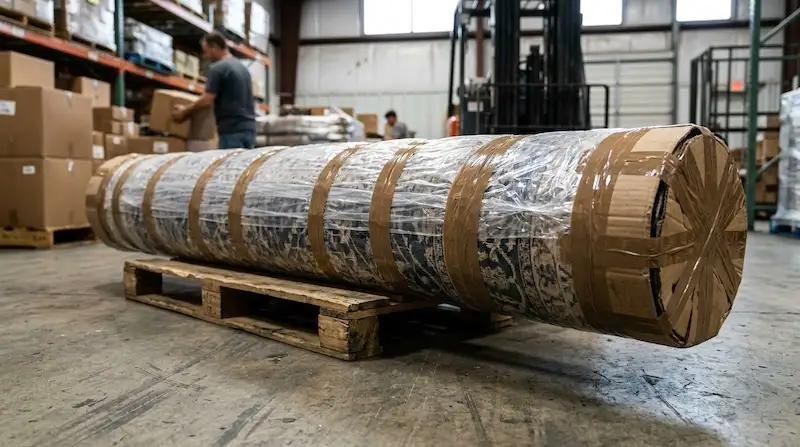
If you are managing the shipping yourself through Poste Maroc or an independent courier, you cannot simply hand them a rolled-up carpet tied with a piece of twine. The package must survive conveyor belts, cargo holds, forklift pallets, and varying weather conditions.
First, ensure the rug is completely dry. Any moisture trapped inside during a long journey will cause mold, ruining your purchase. Roll the rug as tightly as humanly possible, ideally around a sturdy cardboard tube to prevent the center from collapsing and creasing.
Wrap the entire rolled carpet in multiple layers of heavy-duty plastic sheeting or thick trash bags. Tape every single seam with high-quality packing tape. The goal is to make the bundle entirely waterproof. For the outer layer, wrap the plastic in burlap or a heavy canvas sack, stitching or taping it closed. This protects the plastic from tearing during transit. Finally, tape your shipping labels to the outside, but also place a duplicate label or a piece of paper with your name, address, and phone number directly on the carpet inside the plastic wrap, just in case the outer labels are destroyed.
Insurance: Is It Worth It?
When examining the finest rugs Marrakech has available, you might be spending thousands of dollars on a vintage piece. If you are using a courier or the postal service, standard shipping usually only covers a fraction of that value in the event of loss or damage (often calculated by weight, not actual value).
Always purchase additional transport insurance for the full declared value of the item. It typically only adds 1% to 3% to your total shipping cost, but it provides immense peace of mind. Ensure you have the original receipt, as the insurance company will demand proof of value if you need to file a claim. Note that most shipping insurance covers total loss or catastrophic damage, but it rarely covers minor issues like a snagged thread or slight crushing during transit.
Summary Checklist for a Stress-Free Experience
To summarize, the key to successfully navigating international logistics lies in preparation. Follow this checklist to ensure your textile treasure makes it home:
- Research baggage fees before you fly; taking it with you is almost always cheapest.
- Do not reveal how you plan to transport the item until the final price is negotiated.
- Insist the vendor vacuum-seals the carpet to reduce its physical footprint.
- If using the merchant’s shipper, sign the back of the rug and photograph it.
- Never leave the shop without an official airway bill or tracking number.
- Research your home country’s import tax rates so you are not surprised by a massive bill upon delivery.
- Always pay for supplemental shipping insurance for high-value purchases.
Conclusion: The Reward of Patience
Shipping a heavy textile from North Africa across the globe involves trust, paperwork, and financial planning. It can feel daunting when you are standing in a hot, crowded souk trying to do mental currency conversions. But understanding the mechanisms of how to handle rugs Marrakech style gives you a massive advantage.
When you are well-informed, you strip away the anxiety of the unknown. You can confidently negotiate inclusive deals, choose the courier that fits your timeline and budget, and accurately anticipate customs fees. The minor bureaucratic headaches will fade quickly, but that beautiful, hand-knotted carpet will elevate your home’s aesthetic and serve as a stunning conversation piece for decades to come.
Frequently Asked Questions About Shipping Rugs from Marrakech
How long does it take to ship a rug from Marrakech to the US or Europe?
Transit times depend entirely on your chosen method. Private couriers like DHL or FedEx typically deliver to North America and Europe within 3 to 7 business days. If you use Poste Maroc (Amana) or standard sea freight, expect the journey to take anywhere from three weeks to three months.
Can I track my rug once it leaves Morocco?
Yes, but tracking reliability varies. Major international couriers provide real-time, step-by-step tracking numbers. If you use the local postal service, the tracking updates may stall for weeks while the package waits in customs or crosses the ocean, only updating once it reaches your home country.
Can I track my rug once it leaves Morocco?
Yes, but tracking reliability varies. Major international couriers provide real-time, step-by-step tracking numbers. If you use the local postal service, the tracking updates may stall for weeks while the package waits in customs or crosses the ocean, only updating once it reaches your home country.
What should I do if the wrong rug arrives at my house?
This highlights why signing the back of your rug before it is shipped is crucial. If the wrong item arrives, contact the merchant immediately with photos of the delivered rug versus your original photos. Reputable dealers will rectify the mistake. If they refuse, and you paid by credit card, you can initiate a chargeback using your photographic evidence.
If the merchant offers “free shipping,” do I still pay customs duties?
“Free shipping” negotiated in the medina only covers the freight cost from Morocco to your border. It does not cover your own government’s import taxes or VAT. You are still legally responsible for paying any customs duties required by your country before the courier will release the package to your door.
Will vacuum-sealing my rug for the flight damage it?
No, vacuum-sealing is perfectly safe for both wool and cotton rugs. It will not damage the fibers or the knots. However, the rug will be severely creased when you open it. Simply lay it flat in your home, and within a few days, the wool will relax and the creases will naturally disappear.
Start Planning Your Souk Strategy Today
Finding your dream carpet is just the beginning of your medina shopping experience. From hammered brass lanterns to aromatic spices and supple leather bags, the Red City is a shopper’s paradise. Read our definitive guide on What to Buy in Marrakech to discover the best artisan crafts, learn how to spot authentic quality, and avoid tourist traps during your next adventure!