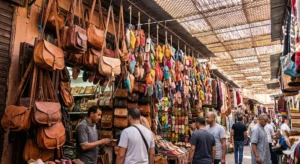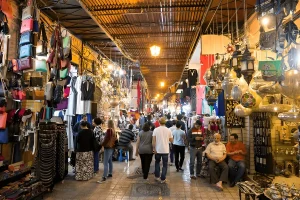
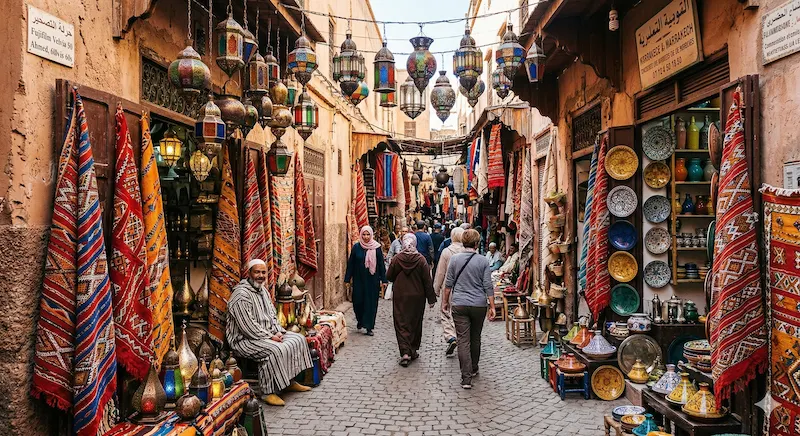

You step through the ancient brick archway and immediately, the sounds of the modern city fade behind a wall of rhythmic hammering, distant melodic calls to prayer, and the persistent “Balak!” of cart-pullers. You are no longer just a traveler; you are a participant in a commerce tradition that has pulsed through these veins for over a millennium. The air is thick with the scent of toasted cumin and cedarwood, and everywhere you look, colors explode—shimmering silk threads, deep indigo dyes, and the glint of hand-hammered brass. This is the sensory overload of the Red City, and your biggest challenge won’t be finding something to take home, but deciding how you will ever fit it all in your suitcase.
Shopping here is an art form, a social contract, and a test of patience all rolled into one. When you wonder what to buy in Marrakech, you aren’t just looking for souvenirs; you are looking for pieces of a living history. Every rug has a story woven into its fibers by a woman in the High Atlas Mountains. Every lantern has been shaped by a master craftsman who learned the trade from his father in a tiny, dimly lit workshop. To help you navigate this labyrinth of temptation, this guide breaks down the essential treasures of the souks, the cultural significance of each craft, and the savvy strategies you need to shop like a seasoned insider.
Table of Contents
The Soul of the Souk: Why You Shop Differently Here
Before you dive into the specific items, you must adjust your mindset. In Marrakech, shopping is not a clinical transaction. You don’t walk into a store, check a price tag, and head to a register. Most items don’t even have price tags. Instead, your purchase is the conclusion of a conversation. You will be offered mint tea. You will discuss the weather, the quality of the wool, and perhaps even the artisan’s family. If you rush, you lose. If you haggle with a smile, you win more than just a lower price—you win respect.
Understanding the geography of the market also helps. The souks are roughly divided by trade. You’ll find the leatherworkers in one area, the blacksmiths in another, and the dyers hanging vibrant skeins of wool over the alleys in their own specific quarter. Knowing this allows you to compare quality across multiple stalls without walking miles between them. Now, let’s explore the categories that define the Moroccan aesthetic.
1. Hand-Woven Berber Rugs and Carpets
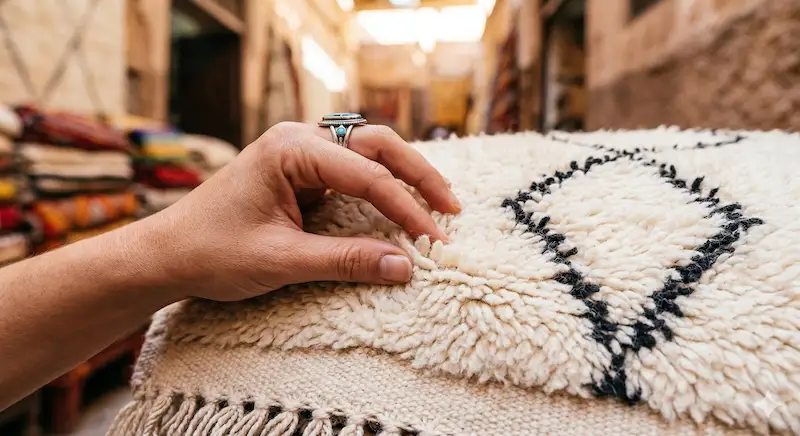
If there is one item that defines Moroccan craftsmanship more than any other, it is the rug. When you ask experts what to buy in Marrakech, the “Boucherouite” or “Beni Ourain” is almost always the first recommendation. These are not factory-made floor coverings; they are ancestral documents. Traditionally woven by Berber women in rural villages, the patterns often represent fertility, protection from the “Evil Eye,” or the weaver’s own life experiences.
- Beni Ourain: These are the iconic creamy-white rugs with minimalist black or brown geometric lines. Made from high-quality undyed wool, they are incredibly soft and fit perfectly in modern, minimalist homes.
- Azilal Rugs: If you love color, look for these. They feature more intricate, often abstract designs and vibrant dyes made from saffron, indigo, and henna.
- Boucherouite: These “rag rugs” are made from recycled textiles. They are eco-friendly, bursting with eclectic colors, and highly durable for high-traffic areas of your home.
Pro Tip: When testing for quality, look at the back of the rug. The knots should be tight and consistent, but slightly irregular—a sign of hand-weaving rather than machine production. If you’re worried about space, don’t be. Most reputable rug dealers in the Medina are experts at vacuum-sealing rugs into small “bricks” for your flight or arranging reliable international shipping.
2. Moroccan Leather Goods: From Babouches to Bags
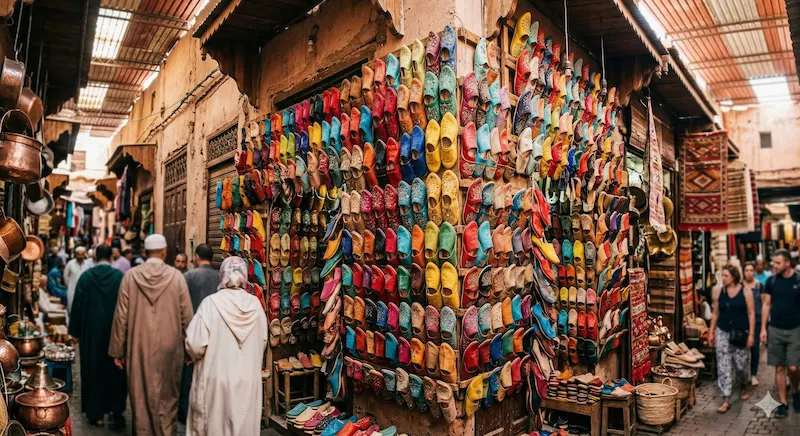
The scent of Marrakech is often the scent of leather. Just outside the main souks lie the ancient tanneries, where hides are still cured using methods that haven’t changed since the 11th century. This raw, organic process results in leather that is incredibly supple and long-lasting. Whether you are looking for a new weekend bag or a pair of traditional slippers, the leather souks offer unmatched value.
The Iconic Babouches
You will see these pointed or rounded slippers in every color of the rainbow. Known as babouches, they are the standard footwear for locals. Look for the ones with a thick, durable sole if you plan to wear them outside, or the soft-soled versions for the ultimate house slipper. The best quality babouches are made from goat leather, which is softer and more flexible than cow leather.
Bags, Belts, and Poufs
Leather satchels and backpacks here are often heavy-duty and develop a beautiful patina over time. You’ll also see unstuffed leather poufs. These are a fantastic buy because they take up almost no room in your luggage. You simply buy the cover and stuff it with old pillows or blankets once you get home to create a stylish, functional piece of Moroccan decor.
3. The Apothecary Experience: Spices and Natural Beauty
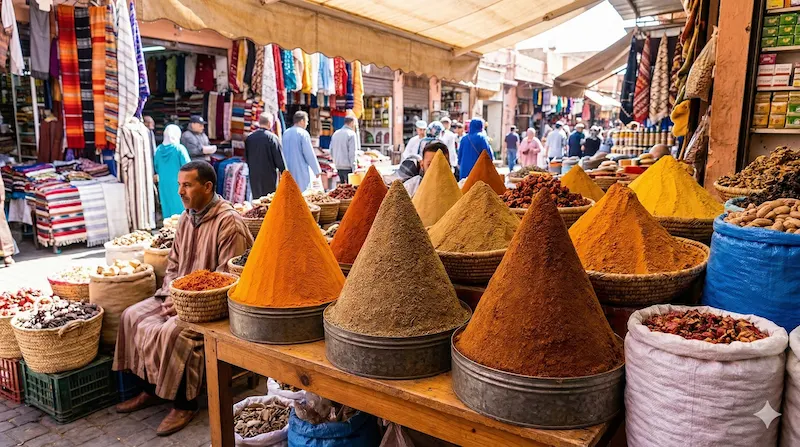
Walking into a Moroccan spice square (Rahba Kedima) is like entering a laboratory of the ancient world. Great conical mounds of brightly colored powders line the shop fronts, and the air tingles with the aroma of Ras el Hanout. Buying spices here is about more than just cooking; it’s about medicinal tradition and natural beauty secrets.
- Saffron: Known as “Red Gold,” authentic Moroccan saffron comes from the Taliouine region. It should be deep red, not yellow. Be careful of “cheap” saffron; it’s often dyed corn silk. True saffron is expensive but worth every dirham for the flavor it imparts.
- Argan Oil: Often called “Moroccan Oil,” this is extracted from the kernels of the Argan tree. You’ll find two types: culinary (toasted and nutty) and cosmetic (clear and odorless). Ensure you buy from a reputable cooperative to guarantee it hasn’t been diluted with vegetable oil.
- Black Soap and Kessa Mitts: If you’ve experienced a traditional Hammam, you’ll want to take the ritual home. Savon noir is a paste made from crushed olives and eucalyptus. Pair it with a kessa (exfoliating glove) for the best skin of your life.
4. Ceramics and Pottery: Fez Blue and Safi Earth
Moroccan pottery is a masterclass in geometric precision. Most of the high-end ceramics you find in Marrakech are actually produced in Fez (known for its intricate patterns and signature cobalt blue) or Safi (known for its earthy tones and heavy textures). When considering what to buy in Marrakech, look for pieces that balance utility with art.
You can find everything from massive serving platters to tiny salt-and-pepper shakers. Tagines are the most popular purchase, but a word of warning: the highly decorated, painted tagines are usually for serving only. If you want to actually cook a slow-simmered lamb dish at home, you need to buy a plain, unglazed clay tagine that can withstand the heat of a stove or oven.
5. Metalwork and the Glow of Moroccan Lanterns
As the sun sets over the Medina, the city begins to glow from within, thanks to the thousands of hand-cut lanterns that line the streets. Moroccan metalwork is incredibly detailed. Artisans use tiny saws to cut intricate patterns into sheets of brass, copper, or silver-plated metal. When a candle or bulb is placed inside, these patterns cast mesmerizing “shadow lace” across your walls.
Beyond lanterns, look for hand-engraved brass trays. These are often used as tabletops in Moroccan homes, resting on folding wooden legs. They are a great way to bring a touch of a Riad’s elegance into your own living room. Again, many of these trays are light and can be packed flat at the bottom of a suitcase.
6. Textiles, Throws, and Fashion
The weaving tradition in Marrakech extends far beyond rugs. The textile souks are filled with “Sabra” silk—a vegan silk derived from the fibers of the agave cactus. It is incredibly soft, has a beautiful sheen, and is surprisingly heavy, making it perfect for bedspreads and throw pillows.
You should also look for Djellabas and Kaftans. While these are traditional Moroccan garments, many modern designers in Marrakech are creating contemporary versions that use traditional embroidery techniques on lightweight linen or cotton. These are perfect for summer vacations or as unique evening wear back home. Don’t forget to look for hand-loomed wool blankets from the Atlas Mountains, often finished with oversized pompoms—a major trend in global interior design.
How to Negotiate Like a Local: 5 Golden Rules
You’ve identified what to buy in Marrakech, but now comes the hard part: the price. Haggling is expected, and if you don’t do it, you’re actually denying the shopkeeper a part of their cultural tradition. Follow these rules to get a fair price without the stress:
- Decide your “Walk Away” price before you start: How much is that item worth to you? Once you have that number in mind, the process becomes much easier.
- Let them name the first price: Always ask “How much?” first. Their opening offer will be high—likely three to four times the actual value. Don’t be offended; it’s just the starting line.
- Counter-offer low, but not insulting: A good rule of thumb is to offer about 1/3 of their starting price. You will eventually meet somewhere in the middle.
- Use the “Walk Away” move: If you can’t reach a price you like, thank them and start to walk away. Nine times out of ten, they will call you back with their “final, final” offer, which is usually the lowest price they are willing to accept.
- Stay lighthearted: Use humor. If the price is too high, tell them you’d have to sell your shoes to afford it. Keep the energy positive, and never get angry. It’s a game!
The Logistics: Shipping and Carrying Your Treasures
One of the biggest hurdles to shopping in Marrakech is the physical limit of your luggage. However, the Red City is a global export hub. If you fall in love with a 6-foot tall lantern or a massive dining room rug, you have options.
Most major shops have accounts with DHL or FedEx. They will pack the item securely and provide you with a tracking number. While shipping can be expensive, remember that the “Medina price” of the item plus shipping is almost always significantly cheaper than buying the same authentic item in a high-end boutique in London, Paris, or New York. For smaller items, consider bringing a foldable “duffle bag” in your suitcase that you can fill with textiles and leather goods for the flight home.
Ethical Shopping: Supporting the Artisans
As you explore the souks, try to seek out cooperatives, particularly those supporting women weavers or disabled artisans. Buying directly from the person who made the item ensures that a larger portion of your money stays with the creator. In the “Ensemble Artisanal” on Avenue Mohammed V, prices are fixed and the quality is guaranteed, making it a great place to start your shopping journey to get a baseline for prices and quality before you head into the more chaotic Medina souks.
Common Shopping Pitfalls to Avoid
While the souks are generally safe and friendly, you should be aware of a few common issues. First, be wary of anyone who offers to “guide” you to the “best” or “cheapest” shop. These are often unlicensed guides who receive a commission from the shopkeepers, which will be added to your final price. It is much better to find your own way.
Secondly, be careful with antiques. Morocco has strict laws about the export of genuine national heritage items. If a dealer tells you a rug is 100 years old, it likely isn’t—and if it is, you might have trouble getting it through customs. Buy items because you love the way they look and feel, not as an “investment” in an antique.
Your Marrakech Shopping Checklist
Before you head out into the rose-colored streets, keep this quick reference of the best-value items in mind:
- Beni Ourain Rugs: Authentic, wool, minimalist.
- Leather Poufs: Buy them unstuffed to save space.
- Ras el Hanout: The “King of Spices”—a blend of up to 30 ingredients.
- Sabra Silk Throws: Vegan silk with incredible durability.
- Argan Oil: Pure, golden, and packed with nutrients.
- Babouches: The ultimate souvenir that you’ll actually use.
Frequently Asked Questions: Shopping in the Marrakech Souks
How can I tell if a Moroccan rug is high quality?
To verify the quality of a Berber rug, always look at the back. Hand-knotted rugs will have slightly irregular knots, whereas machine-made ones are perfectly uniform. Another traditional “burn test” involves pulling a small thread from the fringe; real wool will singe and smell like burnt hair, while synthetic fibers will melt like plastic. Finally, the heavier and denser the rug, the higher the knot count and the more durable it will be.
Is it safe to arrange shipping for large items like furniture or rugs?
Yes, most established shops in the Medina regularly ship internationally via DHL, FedEx, or specialized freight forwarders. However, never pay for shipping in cash without receiving a formal receipt and a tracking number. It is also wise to take a photo of the item and the merchant’s business card. For very expensive purchases, consider using your own shipping insurance or paying with a credit card that offers buyer protection.
Do shopkeepers in the Marrakech souks accept credit cards?
While larger boutiques and high-end rug or lantern shops usually accept Visa and Mastercard, the vast majority of smaller stalls and spice vendors are strictly cash-only. Always carry Moroccan Dirhams (MAD) for your daily shopping. If you do use a card in a larger shop, be aware that some merchants may add a 3% to 5% surcharge to cover the bank’s processing fees.
How do I know what price I should actually be paying?
The “right” price is essentially whatever you are happy to pay for the item. However, a good strategy to find a baseline is to visit the Ensemble Artisanal on Avenue Mohammed V. This is a government-run complex with fixed prices. Once you know what a high-quality leather bag or ceramic bowl costs there, you can head into the Medina and aim to negotiate a price that is 10% to 20% lower than the fixed-price government standard.
What are the restricted items that I cannot export from Morocco?
Morocco has strict heritage laws protecting its history. You are generally prohibited from exporting genuine fossils, protected animal species (like tortoiseshell or certain skins), and “national treasure” antiques (items over 100 years old) without a special permit from the Ministry of Culture. When buying “antique” jewelry or rugs, ensure the seller provides a certificate stating it is a contemporary craft or a non-restricted item to avoid issues at customs.
Conclusion: Bringing the Magic Home
The items you buy in Marrakech are more than just physical objects; they are vessels for your memories. Every time you see that lantern cast its geometric shadows on your bedroom wall, or feel the softness of your Berber rug under your feet, you will be transported back to the chaotic, beautiful heart of the Red City. You’ll remember the taste of the mint tea, the sound of the metalworkers’ hammers, and the thrill of the hunt.
Now that you know exactly what to buy in Marrakech and how to navigate the intricate social dance of the souks, you are ready to build your own collection of Moroccan treasures. Don’t be afraid to get lost, don’t be afraid to haggle, and most importantly, follow your intuition. If an item speaks to you, it belongs in your home.
Want to make your shopping experience even smoother? Book one of our hand-picked Medina Shopping Tours to have an expert local guide show you the hidden workshops and help you negotiate the best prices for authentic crafts. Don’t just visit the souks—conquer them!