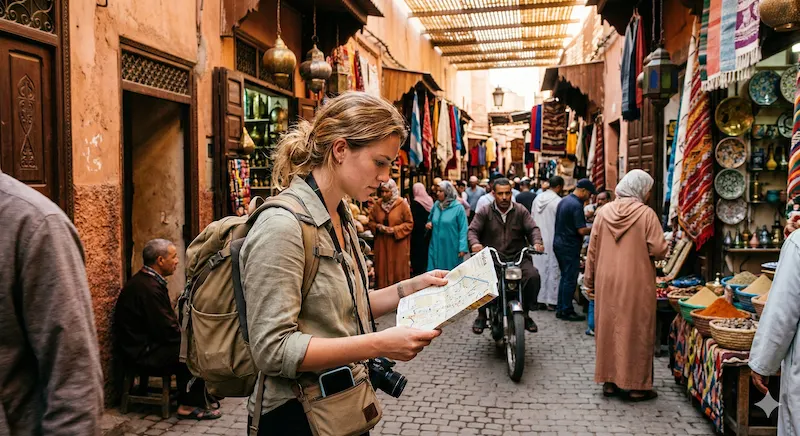

Stepping through the massive horseshoe arches of Bab Bou Jeloud or Bab Agnaou into the ancient heart of the city is like stepping across a threshold in time. Instantly, the modern world of wide boulevards and traffic lights disappears. In its place, you are swallowed by a high-walled, rose-tinted labyrinth that has been bustling with trade, life, and movement for nearly a thousand years. The smells of cumin, tanning leather, and exhaust fumes mingle in the hot air. Motorbikes weave past hand-drawn carts, and a chaotic symphony of bargaining, call to prayer, and the constant shout of “Balak!” fills your ears.
You have arrived. But knowing you are here and knowing where you are going are two entirely different concepts. Mastering on-foot movement within these walls is the ultimate, and arguably the most difficult, phase of your overall Marrakech transport strategy. You cannot hail a cab here. You cannot rely on a bus. Your own two feet, your sense of direction, and your situational awareness are your only vehicles.
The old city was intentionally designed to confuse invaders, and centuries later, it does a remarkably good job of confusing tourists. This comprehensive Marrakech Medina walking guide will equip you with the mental tools, the digital hacks, and the street-smart strategies you need. We are going to break down exactly how to navigate Marrakech Medina, turning what is often a stressful ordeal into the most rewarding adventure of your Moroccan journey.
Table of Contents
The Reality of Getting Lost in Marrakech
The very first thing you must do before you even leave your Riad is accept a fundamental truth: you are going to get lost. It is not a possibility; it is an absolute certainty. The ancient urban planning of the city defies modern logic. Streets do not run in grids. They curve, branch off at strange angles, narrow into claustrophobic tunnels, and frequently end abruptly at heavy wooden doors.
Getting lost in Marrakech is practically a rite of passage. If you fight this reality, you will spend your entire vacation frustrated, staring at a screen, and arguing with your travel companions. If you embrace it, you unlock the true magic of the city. The most stunning artisan workshops, the quietest neighborhood bakeries (furan), and the most beautiful carved cedar doorways are never found on the main thoroughfares. They are hidden deep within the residential alleys, waiting to be stumbled upon by someone who took a wrong turn.
Your goal is not to avoid getting lost entirely. Your goal is to learn how to get “safely lost”—knowing how to wander freely while retaining the ability to find your way back to recognizable ground when you need a rest, a meal, or a bathroom. Understanding the difference between wandering and being stranded is the foundation of your survival map.
Essential Tools for Your Orientation
You might think your thousand-dollar smartphone will save you here. It will not. Relying solely on standard digital mapping is the fastest way to end up walking in circles for hours.
Why Google Maps Fails You Here
In most cities, a blue dot on a digital map is your best friend. Inside these ancient walls, that blue dot is a known liar. The alleyways are incredibly narrow, and the buildings are constructed from thick, dense rammed earth and clay. Furthermore, many of the pathways are covered by bamboo roofs or tarps to block the sun. This creates a massive GPS bounce effect.
Your phone will struggle to catch a satellite signal. Your location dot will jump three streets over, spin wildly, or freeze entirely. It will confidently tell you to turn left into what is clearly a solid brick wall. You cannot rely on live, turn-by-turn digital navigation. It will betray you.
The Power of Offline Maps Marrakech
Because live GPS tracking is highly erratic, and cellular data can drop out deep in the souks, you must have a reliable fallback. Before you leave your hotel Wi-Fi, you need to set up offline maps. While you can download a Google area map for offline use, specialized applications often have much better data for pedestrian-only zones.
Download an application like Maps.me or OsmAnd. These platforms rely on open-source data, which means thousands of previous travelers and locals have painstakingly mapped out the tiny pedestrian alleys that standard satellite cars cannot see. Before your trip, pin your Riad, Jemaa el-Fnaa square, and a few major landmarks. Even when your GPS bounces, having a highly detailed, statically loaded Marrakech Medina map allows you to cross-reference street names (when you can find them) with the twisting lines on your screen to manually figure out your position.
Physical Landmarks vs. Street Signs
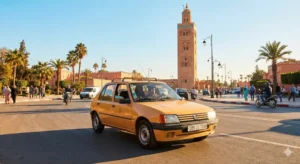
Look up. Do not look down at your phone; look at the horizon. The Medina is largely flat, which means the towering minaret of the Koutoubia Mosque is visible from many different rooftops and open squares. It is your North Star. If you can spot the Koutoubia, you immediately know which direction leads to Jemaa el-Fnaa.
Relying on street signs is a futile effort. Many alleys simply do not have signs. When they do, they are often written only in Arabic, or they might be painted over, faded, or pointing in ambiguous directions. Instead of looking for a sign that says “Derb Dabachi,” look for physical waypoints: a particularly large fountain, a distinctively painted archway, a massive banyan tree, or a specific artisan’s shop. You must learn to navigate by visual memory.
How to Navigate Marrakech Medina Like a Local
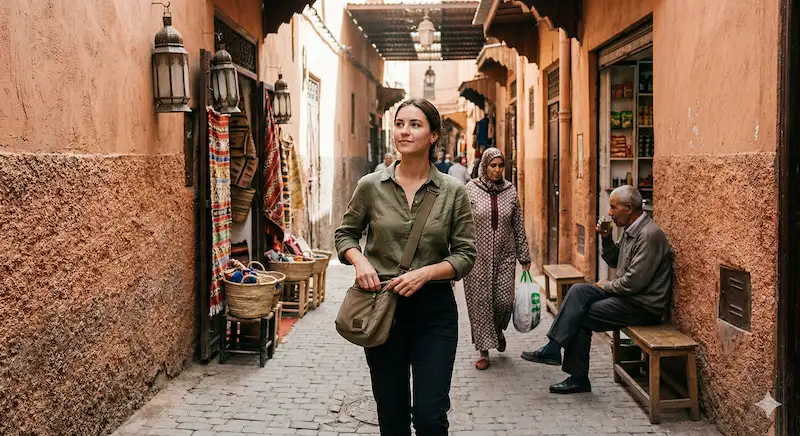
Walking these streets requires a specific rhythm and a set of unwritten rules. If you walk like you do in a modern Western city—head down, earbuds in, assuming you have the right of way—you will quickly run into trouble, or quite literally, run into a donkey.
The “Balak!” Warning
The alleys are the arteries of commerce. Everything moving in and out of the old city—crates of mint, sides of beef, construction materials, carpets—must be transported through these narrow corridors. There are no delivery trucks.
You will hear the word “Balak!” shouted constantly. It roughly translates to “Watch out!” or “Make way!” When you hear this shout behind you, do not freeze, and do not look over your shoulder to see what it is. Immediately step to the side and flatten yourself against the nearest wall.
It might be a man pushing a heavily loaded wooden handcart with no brakes. It might be a motorcycle weaving through the crowd. Or, very frequently, it might be a donkey carrying butane gas canisters. The rule of the road here is that pedestrians yield to everything else. The larger and heavier the object, the more right of way it commands. Stay alert, keep your head on a swivel, and move swiftly when commanded.
Reading the Architecture
The physical structure of the streets offers clues about where they lead, if you know what to look for. You need to distinguish between a main artery and a “derb” (a residential alley).
Main arteries are lined with shops, cafes, and open storefronts. The ground is often paved with smooth concrete or larger stones to accommodate heavy carts. If you are on a street filled with commerce, it will eventually lead you to a major gate or a large square.
A derb, on the other hand, is residential. The walls will be mostly blank, punctuated only by heavy, closed doors. If you turn down a derb, the noise of the market will suddenly drop away. Pay attention to the archways above you. If an archway is very low, or if the street suddenly narrows significantly, you are likely heading toward a dead end. If the paving changes from smooth stone to hexagonal tiles, you are almost certainly entering a private residential block that will not connect to the next street. When in doubt, follow the flow of the heaviest foot traffic.
The Right Way to Ask for Directions
This is where many travelers make a critical mistake. When you realize you are hopelessly lost, your instinct is to stop and look confused. This immediately broadcasts your vulnerability.
Within seconds, a young man or a teenager will likely approach you, offering to show you the way. They might tell you “The square is closed,” “That way is blocked for prayer,” or “Tanneries are this way.” Ignore them. Do not engage, do not argue, just say a firm “La, shukran” (No, thank you) and keep walking confidently, even if you don’t know where you are going.
These are “faux guides.” Their goal is to lead you deep into the labyrinth, take you to a friend’s shop, or demand a surprisingly high amount of money for showing you a route you could have found yourself. They can become aggressive if you refuse to pay them after they have “helped” you.
If you genuinely need directions, you must choose who to ask. Walk into a shop and ask the shopkeeper who is sitting behind a counter. Ask a woman walking with her children. Ask an older man sitting outside a cafe. These individuals are stationary and have a vested interest in the reputation of their neighborhood. They will point you in the right direction for free, out of genuine Moroccan hospitality. Never ask a young man loitering on a corner.
Souk Navigation: Mastering the Markets
The souks are the commercial heart of the city, a dense network of covered markets stretching north from Jemaa el-Fnaa. This is where the sensory overload hits its peak, and where souk navigation becomes an intense psychological exercise.
The Main Arteries
To keep your bearings, you need to understand the spine of the market. There are two primary arteries leading north from the big square: Souk Semmarine and Souk Mouassine.
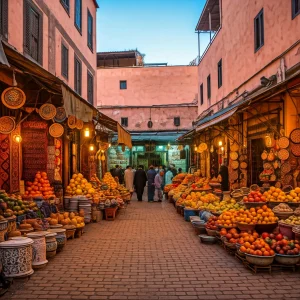
Souk Semmarine is the widest, busiest, and most overwhelming. It is covered by a high iron trellis. It sells a bit of everything: pottery, textiles, tourist trinkets, and leather. If you follow it far enough, it forks. The right fork leads to the spice square (Rahba Kedima), and the left fork delves deeper into specialized artisan areas.
Souk Mouassine runs parallel to the west. It is slightly quieter, slightly more upscale, and leads toward the beautifully restored Dar el Bacha museum area.
Think of these two streets as your main highways. Whenever you plunge into the tiny, dark, specialized alleys—like the ironworkers’ souk or the dyers’ souk—your goal is simply to eventually navigate back to one of these two main, brightly lit thoroughfares.
Mental Breadcrumbs
As you dive deeper into the market, you must actively drop mental breadcrumbs. The shops begin to look identical after an hour. You cannot rely on “the shop with the blue plates” because there are five hundred shops with blue plates.
Instead, look for permanent, structural anomalies. Note the spot where a massive palm tree grows awkwardly right through the middle of a shop roof. Remember the intersection where a beautifully tiled, ancient public water fountain (a saqqa) stands. Take note of a corner where a specific, pungent smell of cedar wood dominates the air. If you need to retrace your steps, you navigate from the cedar smell back to the fountain, and back to the tree.
When you have had enough and the sensory input becomes too much, stop trying to find a specific exit. Simply ask any shopkeeper, “Jemaa el-Fnaa?” They will point. Walk fifty meters, ask the next shopkeeper, “Jemaa el-Fnaa?” and they will point. Follow the chain of pointing fingers, and eventually, the narrow alleys will spit you back out into the wide open space of the main square.
Is Marrakech Medina Safe at Night?
This is one of the most common anxieties for first-time visitors. The idea of walking through dimly lit, narrow, medieval alleys after dark sounds like a scenario from a thriller movie. However, the reality of the situation is surprisingly reassuring.
The short answer to the question “Is Marrakech Medina safe at night?” is yes. It is generally very safe, often safer than many major European or American cities. Violent street crime against tourists is exceedingly rare. The Moroccan economy relies heavily on tourism, and the local authorities police the old city heavily, often with plainclothes officers, to ensure the safety of visitors.
The Shift in Atmosphere
As the sun sets, the atmosphere transforms. The aggressive sales tactics in the souks tend to soften. The chaotic handcarts finish their deliveries. The main arteries actually become easier to walk as the frantic daytime commerce slows down. Families come out to stroll, eat street food, and socialize. The major thoroughfares leading to and from Jemaa el-Fnaa remain crowded and brightly lit until well past midnight.
Common Sense Rules for After Dark
While the risk of violent crime is low, petty theft and scams do increase slightly under the cover of darkness. You still need to exercise basic urban street smarts.
- Stick to the Main Veins: If you are walking back to your Riad after dinner, try to use the larger, well-lit streets as much as possible. Avoid taking a “shortcut” through a pitch-black residential derb you are unfamiliar with.
- Walk with Purpose: The “faux guides” are more active at night, preying on tourists who look lost and tired. Walk confidently. If you need to check your map, step inside a well-lit cafe or shop to do it, rather than standing confused under a flickering streetlamp.
- Secure Your Belongings: Pickpockets operate in the dense crowds of Jemaa el-Fnaa at night. Keep your phone in a front pocket, wear cross-body bags securely, and do not flash large amounts of cash.
- Riad Escorts: If your accommodation is located deep in a dark alley, do not hesitate to call the Riad staff when you are finishing dinner. Almost all good guesthouses will happily send a staff member to meet you at a nearby landmark and walk you back to the door. It is a standard service, and you should use it.
The Psychological Survival Map
Ultimately, learning how to navigate Marrakech Medina is less about maps and more about mindset. The architecture is designed to overwhelm you. The sounds and smells are designed to disorient you. The key to surviving, and thriving, is managing your own psychology.
When you realize you are lost, do not panic. Do not immediately stare at your phone in frustration. Stop walking. Take a deep breath. Look around you. You are standing inside a living, breathing medieval city—a UNESCO World Heritage site. Notice the intricate tilework on the wall next to you. Listen to the rhythmic tapping of an artisan shaping brass in the next alley.
If you feel overwhelmed, look for a staircase. Many cafes hidden in the souks have rooftop terraces. Climb up. Getting above the claustrophobic alleys, drinking a hot glass of sweet mint tea, and looking out over the flat rooftops toward the Atlas Mountains will instantly reset your nervous system. You will see the Koutoubia minaret, you will regain your bearings, and you will be ready to dive back into the beautiful chaos.
Frequently Asked Questions About Visiting Marrakesh
What is the best time of year to visit Marrakesh?
Spring (March to May) and autumn (September to November) are generally considered the best times to visit. During these months, the weather is pleasantly warm, making it ideal for exploring the city’s sights and souks. Summers can be extremely hot, with temperatures often exceeding 40°C (104°F), while winters are mild but can have chilly evenings.
Is it safe to travel to Marrakesh?
Yes, Marrakesh is generally a safe city for tourists. However, like any popular destination, it’s important to be aware of your surroundings and take standard precautions. Be mindful of pickpockets in crowded areas, especially in the souks and Jemaa el-Fnaa square. It’s also advisable to avoid walking alone in poorly lit or unfamiliar areas at night. Use common sense and you should have a safe and enjoyable trip.
What should I wear in Marrakesh to respect local culture?
Morocco is a conservative country, and it’s respectful to dress modestly, especially when outside of tourist resorts. For women, this means covering shoulders and knees. Loose-fitting clothing, such as long skirts, dresses, or linen trousers and t-shirts, is a good choice. For men, t-shirts and long shorts or trousers are appropriate. While you may see some tourists in shorter clothing, dressing respectfully will help you blend in and avoid unwanted attention. When visiting mosques, both men and women must cover up completely.
How can I avoid being scammed in the souks of Marrakesh?
The souks are one of Marrakesh’s biggest highlights, but they can also be overwhelming. To avoid common scams:
Be Prepared to Haggle: Haggling is expected in the souks. Never accept the first price offered. Aim for about 50% of the initial asking price and go from there.
Be Wary of “Free” Gifts or Help: If someone offers you a “gift” or insists on showing you the way, politely but firmly decline. They will likely expect payment later.
Know Your Prices: Do some research or ask at your riad for a general idea of what common items should cost.
Don’t Feel Pressured: It’s perfectly okay to walk away if you’re not comfortable with a price or a seller.
Keep Your Belongings Secure: Use a money belt or a secure cross-body bag to prevent pickpocketing.
Do I need to learn Arabic to visit Marrakesh?
No, you don’t need to learn Arabic to visit Marrakesh. Moroccan Arabic (Darija) is the main language spoken, but French is also widely understood and used, especially in business and tourism. In tourist areas, you’ll find that many people also speak English, Spanish, and German. Learning a few basic Arabic phrases like “Salam” (Hello), “Shukran” (Thank you), and “La” (No) is always appreciated by locals, but you’ll be able to communicate effectively in major tourist destinations using English or French.
Mastering the Maze
You cannot conquer the old city with a GPS signal and a rigid schedule. You conquer it with patience, visual observation, and a willingness to surrender to the flow of the alleys. By downloading your offline tools, learning the physical cues of the streets, and ignoring the aggressive hustlers, you strip away the stress of the labyrinth.
Embrace the detours. Let the winding paths pull you toward hidden gardens, subterranean bakeries, and quiet courtyards you would never have found on a planned route. Once you stop fearing the maze, you finally start experiencing the real Morocco.
Ready to step out into the chaos with confidence? Download our free, highly detailed offline Medina map with pre-pinned landmarks and safe walking routes right to your phone, and start exploring like a local today.