

When it comes to Petit Taxi vs Grand Taxi, the choice begins the moment you have just stepped off the plane or train, and the vibrant energy of Marrakech hits you immediately. The air smells of warm spice and dust, the sounds of commerce are loud, and the traffic seems to operate on a set of rules you haven’t quite deciphered yet. You need to get to your Riad or hotel, and suddenly you are faced with a confusing array of vehicles. Some are small and beige, zipping through narrow gaps. Others are large, sometimes ancient-looking Mercedes sedans, waiting in queues.
Welcome to the dual-layered world of Moroccan taxis. Understanding the difference between the two main types—the Petit Taxi and the Grand Taxi—is arguably the most crucial skill you need for mastering the broader ecosystem of Marrakech transport. Choosing the wrong one can lead to paying triple the price, getting stuck at the city limits, or simply being refused service.
This guide will demystify the system. We will break down exactly what defines these two distinct services, the unwritten rules of engagement for each, and precisely when you should hail the little beige hatchback versus when you need to negotiate with the big Mercedes.
Table of Contents
Understanding the Marrakech Taxi Landscape
Before diving into the specifics, you need to understand why this division exists. Unlike many Western cities where a taxi is a taxi, Morocco has developed a tiered system to handle different transportation needs. This isn’t just about car size; it’s a regulatory distinction that dictates where drivers can go and how they charge.
Think of it this way: The city needs agility for short, urban hops within congested traffic, but it also needs connectivity to outlying suburbs, villages, and tourist sites like the Atlas Mountains. A single type of service couldn’t efficiently handle both. The Petit Taxi is the urban sprinter, designed for the city center. The Grand Taxi is the marathon runner, built for distance and heavier loads. Knowing which “athlete” you need for your specific journey is the key to a smooth trip.
The Petit Taxi: Your Urban Companion
If you are spending a day exploring the gardens of Gueliz, heading to dinner in Hivernage, or just trying to get as close as possible to Jemaa el-Fnaa, the Petit Taxi is your best friend. They are ubiquitous, relatively cheap (when used correctly), and agile enough to navigate chaotic traffic circles.
How to Spot a Petit Taxi
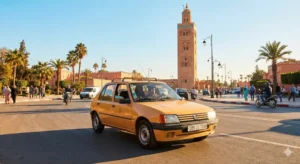
In Marrakech, this is easy. Every official city taxi is painted the same distinct shade of creamy beige or ochre. They are small hatchbacks, typically Fiat Unos, Peugeot 208s, or Dacias. You will see a small “Petit Taxi” sign on the roof. If it’s not beige, it’s not a licensed Marrakech city cab, regardless of what the driver tells you.
The Rules of Engagement: Meters and Sharing
Using a Petit Taxi seems straightforward, but there are cultural nuances that often confuse first-time visitors. Mastering these will save you frustration.
- The Sacred Meter (Compteur): By law, Petit Taxis must use a meter. When you get in, ensure the driver flags it down. It should start around 1.70 to 2.40 MAD (Dirhams) during the day. If a driver tries to quote you a flat price for a trip inside the city (e.g., “50 Dirhams to the square”), they are trying to overcharge you. Politely ask for the “compteur.” If they refuse, simply close the door and hail the next one. There are thousands of them; you hold the power in this negotiation.
- The Three-Passenger Limit: This is a strict rule. A Petit Taxi is insured to carry a maximum of three passengers. It doesn’t matter how small you are or if you are willing to squeeze. If you are a party of four, you must either take two Petit Taxis or find a Grand Taxi.
- The Shared Ride Concept: This surprises many tourists. You hail a taxi, get in, and two minutes later the driver slows down to pick up another person waving on the side of the road. This is standard practice. As long as the new passenger’s destination is roughly in the same direction, the driver is allowed to maximize their fare. Don’t worry, your meter keeps running just for your trip.
- The Night Rate Surcharge: Be aware that as soon as evening hits (usually 8:00 PM in winter, later in summer), a legal 50% surcharge is added to the metered fare. It happens automatically on newer meters, or the driver will calculate it at the end. This is legitimate and not a scam.
Best Use Cases for a Petit Taxi
You should choose the small ochre cab when your movement is strictly within the urban boundaries of Marrakech. They are perfect for hopping between neighborhoods that are too far to walk, like getting from the Majorelle Garden back to the Koutoubia Mosque. They are essential when the midday heat makes walking unbearable. However, keep in mind that they cannot enter the deep, narrow alleyways of the ancient Medina. They will drop you at the nearest accessible gate (“Bab”) or large square, and you will have to walk the rest of the way to your Riad.
The Grand Taxi: The Long-Haul Workhorse
While the Petite Taxis buzz around the city center like busy bees, the Grand Taxis are the beasts of burden meant for heavier lifting and longer distances. If your plans involve leaving the city limits, or moving a larger group, you have crossed into Grand Taxi territory.
Identifying the Grand Taxi
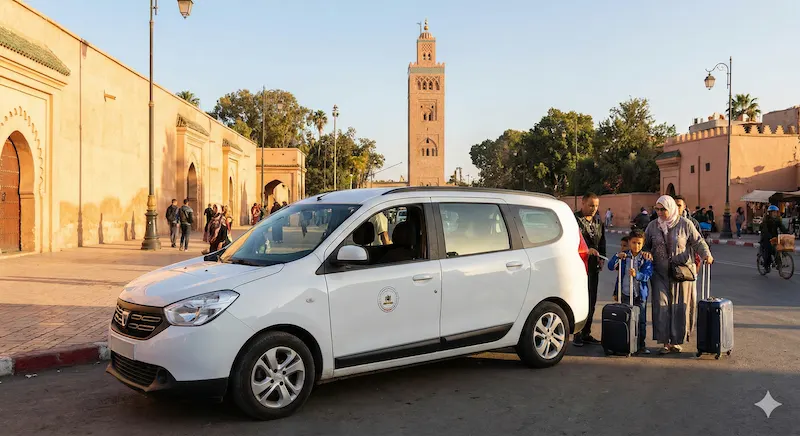
Historically, these were almost exclusively grand old Mercedes-Benz W123s—tanks of the road that had clocked millions of kilometers. Today, Morocco is modernizing the fleet, so you will increasingly see larger Dacia Lodgys, Fiat Doblos, or similar vans. Unlike their smaller cousins, they do not have a uniform color mandated by the city, though many are white, silver, or dusty beige. They are significantly larger and do not have the rooftop sign specifying “Petit.”
How They Operate: Two Distinct Modes
This is where the confusion often lies. Grand Taxis operate in two completely different ways depending on how you engage them. Understanding this distinction is vital for grasping the Petit Taxi vs. Grand Taxi debate.
Mode A: The “Collectif” (Shared, Fixed Route)
This is how locals travel inter-city affordably. Grand Taxis gather at specific “stations” around the city edges (usually near major bus stations or key gates like Bab Doukkala). Each taxi is designated for a specific destination, say, the town of Ourika or Asni.
The taxi waits until it is completely full before departing. In the old Mercedes, this meant two people in the front passenger seat and four squeezed in the back. The newer vans are more comfortable, carrying six passengers legally. You pay for a single seat, which is a fixed, very low price. It is efficient and cheap, but not luxurious. You wait until it fills up, and you go exactly where the route dictates.
Mode B: The “Course” (Private Hire)
As a tourist, this is likely how you will use a Grand Taxi. You can hire the entire vehicle for yourself and your group. This is necessary if you are a group of four to six people wanting to move around the city together, as you don’t fit in a Petit Taxi. It is also how you arrange day trips to tourist sites outside the city if you don’t want a guided bus tour.
Crucially, Grand Taxis do not have meters. When hiring one privately, you must negotiate the price before you get in. You need to have a rough idea of the going rate for your destination to avoid paying a “tourist tax.” For a day trip, you are negotiating for the driver’s whole day, gas included.
Best Use Cases for a Grand Taxi
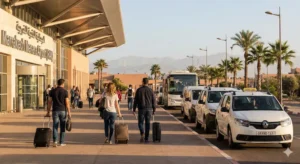
The Grand Taxi is indispensable when your ambitions exceed the city limits of Marrakech. If you want to visit the Atlas Mountains, the coastal city of Essaouira, or the Agafay desert without joining a large coach tour, hiring a private Grand Taxi gives you freedom and flexibility. Within the city, they are your only option if you are traveling as a family of four, five, or six and want to stick together in one vehicle. They are also frequently used for airport transfers, especially for groups or those with significant luggage that wouldn’t fit in the trunk of a small hatchback.
Head-to-Head Comparison: Scenarios and Solutions
To solidify your understanding of when to use which service, let’s look at common real-world travel scenarios you will likely face in Marrakech.
Scenario 1: The Dinner Reservation in Gueliz
You are staying in a Riad near Jemaa el-Fnaa. You have a dinner reservation at a nice restaurant in the modern Gueliz district. It’s 8:30 PM, and you are dressed up and don’t want to walk for 30 minutes.
The Winner: Petit Taxi. Walk to the nearest road accessible to cars near the square. Hail a beige cab. Ensure the meter is on (remember the night surcharge will apply). It’s a quick, direct city hop perfectly suited for the small cab.
Scenario 2: The Day Trip to Ourika Valley
You want to escape the city heat and see the waterfalls in the Ourika Valley. You want to go at your own pace, stop for photos, and not be rushed by a tour group.
The Winner: Grand Taxi (Private Hire). A Petit Taxi is legally forbidden from taking you this far. You need to find a Grand Taxi driver and negotiate a flat rate for the entire day trip. They will drive you there, wait for you while you hike or eat lunch, and bring you back.
Scenario 3: The Family of Five
You are traveling with your spouse and three children. You want to go from your hotel in Hivernage to the Majorelle Garden.
The Winner: Grand Taxi. You literally cannot fit in a Petit Taxi legally. You need to flag down a larger Grand Taxi and negotiate a price for the short city trip, as they won’t use a meter. Alternatively, you could split into two Petit Taxis, but that often complicates logistics.
Scenario 4: The Solo Budget Traveler Heading to Essaouira
You are traveling alone on a tight budget and want to get to the coastal city of Essaouira.
The Winner: Grand Taxi (Collectif Mode). Head to the designated Grand Taxi station for coastal routes. Find the taxi loading for Essaouira. Buy a single seat. Wait for five other people to show up, squeeze in, and enjoy a very cheap, authentic ride to the coast.
Practical Tips for Mastering Moroccan Taxis
Regardless of whether you are in a big taxi or a small one, a few universal rules apply to smooth the friction of getting around Marrakech.
- Cash is King: None of these taxis accept credit cards. Carry cash. More importantly, carry small change (coins, 10 and 20 Dirham notes). Drivers notoriously “never have change” for a 100 or 200 Dirham note, leading to awkward overpayments.
- Know Landmarks, Not Addresses: Street addresses are often useless in Marrakech, especially near the Medina. Don’t tell the driver “14 Derb Snane.” Tell them the nearest famous landmark, big hotel, or city gate (e.g., “Near Cafe de France, Jemaa el-Fnaa” or “Bab Doukkala”).
- Confidence is Key: When negotiating a Grand Taxi or demanding the meter in a Petit Taxi, be polite but firm. If you look unsure, the price will go up. If a driver is being unreasonable, simply walk away. There is always another taxi.
- Navigation Apps Help: While you shouldn’t rely on them for the final 100 meters in the souks, having Google Maps active so you can see if the driver is heading in the general right direction prevents the “scenic route” sometimes taken to run up the meter.
Frequently Asked Questions: Navigating Taxis in Marrakech
1. Can I use a Petit Taxi to go to the Agafay Desert or the Atlas Mountains?
No. Petit Taxis are legally restricted to the urban limits of Marrakech. For any destination outside the city center, such as the Agafay Desert, Ourika Valley, or the airport (in some specific routing cases), you must hire a Grand Taxi or book a private tourist transfer.
2. How many passengers can legally fit in a taxi?
A Petit Taxi is strictly insured for a maximum of three passengers, and drivers will not break this rule. If you are traveling as a family of five—two adults and three children, for example—you cannot ride in a single Petit Taxi. You will need to either hire one of the larger Grand Taxis (which can hold up to six passengers) or split your group into two separate Petit Taxis.
3. Do Marrakech taxis accept credit cards?
No, both Petit and Grand Taxis operate entirely on a cash basis. You must pay in Moroccan Dirhams. It is highly recommended to carry small denominations, like coins and 10 or 20 Dirham notes, as drivers frequently do not have change for large bills (like 100 or 200 Dirhams).
4. Do I need to negotiate the price before getting into the taxi?
This depends entirely on the type of taxi. For a Petit Taxi, you should not negotiate a flat rate; simply ask the driver to turn on the meter (compteur). For a Grand Taxi hired for a private trip, there is no meter, so you must firmly negotiate and agree on the total price before getting inside the vehicle.
5. Is there an extra charge for taking a taxi at night?
Yes. By law, Petit Taxis apply a 50% surcharge to the standard metered fare during nighttime hours. This night rate typically begins at 8:00 PM. On newer meters, this is calculated automatically, while with older meters, the driver will manually add the 50% to the final displayed number.
Making the Right Choice for Your Journey
Navigating the choice between a Petit Taxi and a Grand Taxi isn’t a complicated puzzle once you understand the basic rules of the road in Marrakech. It comes down to two simple questions: How many people are you, and where are you going?
Keep it simple: Use the beige Petit Taxis with the meter running for all your short trips inside the city for up to three people. Switch to the larger Grand Taxis and negotiate a flat price whenever you have a larger group or want to leave the city limits for an adventure. By mastering this distinction, you stop worrying about the logistics of transport and start focusing on the incredible sights and sounds of the Red City.
Don’t let transportation stress define your Moroccan adventure. Internalize these rules, carry small change, and step out onto the street with confidence. Your perfect Marrakech experience is waiting—you just need to hail the right ride to get there.